

When people talk about Japanese female guitarists, names from different parts of the rock scene quickly come to mind. But Rei, also known as Guita Rei, occupies a different position.
She did not emerge from a traditional rock band. Instead, Rei built her career as a singer-songwriter and guitarist, combining blues, rock, pop, jazz and elements of classical music into her own distinctive style.
Born in Itami, Hyogo Prefecture, Rei spent part of her childhood in New York. She began studying classical guitar at the age of four and discovered blues music at five. That combination of classical training, international experience and an early connection with blues became one of the defining characteristics of her music.
Today, Rei is recognized not only as a Japanese singer-songwriter, but also as a guitarist with an international career. She has performed at major festivals around the world, appeared at TED NYC, collaborated with established musicians and even developed her own signature Fender Stratocaster.
Who Is Guita Rei?
Rei was born on February 5, 1993, in Itami, Hyogo Prefecture. She spent part of her childhood in New York, an experience that exposed her to different cultures and musical environments.
The guitar entered her life very early. She began studying classical guitar at four and discovered blues at five.
That background helps explain why her music is difficult to place into a single genre.
Although blues is one of her strongest musical foundations, Rei also incorporates rock, pop, jazz and elements of her classical training. Her songs can move between acoustic passages, guitar riffs, grooves and sections in which the guitar becomes the main voice of the arrangement.
She also sings in both Japanese and English, reflecting her experience between Japan and the United States.
The Guitar Has Always Been at the Center of Her Career
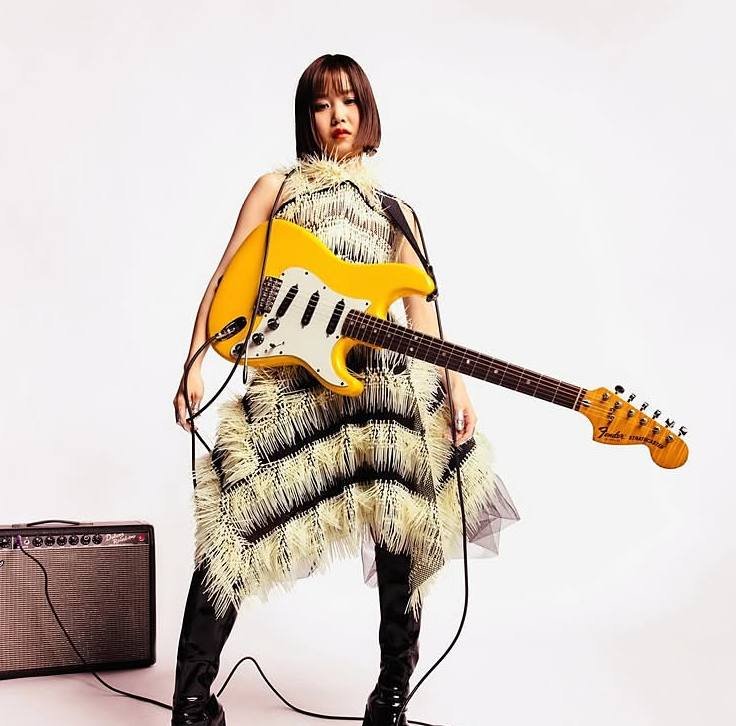
One of the things that separates Rei from many singer-songwriters is that the guitar is not simply an accompanying instrument in her music.
It is a fundamental part of her identity.
From her earliest releases, Rei demonstrated an interest in exploring different guitar techniques and sounds. Her playing combines traditional blues vocabulary with a more contemporary and personal approach.
Rather than relying exclusively on speed or technical virtuosity, Rei uses the guitar to create rhythm, melody and character within her songs.
That is also why her music can appeal to listeners who are not necessarily blues fans.
The guitar is important, but it always serves the composition.
The Beginning of Her Professional Career
Rei began attracting attention in Japan before releasing her first full-length album.
In 2015, she released her first mini-album, BLU, co-produced by Ryosuke Nagaoka of Petrolz.
The release marked the beginning of a new stage in her career.
She soon began appearing at major festivals and events in Japan and overseas, including SXSW, Java Jazz Festival and Les Eurockéennes.
This period was important because it demonstrated that her musical concept could work beyond Japan’s domestic music scene.
Her music already had an international character: Japanese and English lyrics, American blues influences and a guitar-centered approach that did not depend on conventional J-pop formulas.
Rei at TED NYC

One of the most notable moments in Rei’s early career came in 2017.
She performed at TED NYC, becoming the first Japanese musician to give a live performance at the event, according to her official Sony Music Artists biography.
Her TED performance featured “my mama” and “BLACK BANANA.”
The appearance introduced her music to an international audience and highlighted something important about her artistic identity: Rei can put the guitar at the center of a performance without sacrificing songwriting or vocals.
Watch Rei’s TED performance — TED
The REI Album and International Expansion
In 2018, Rei released her album REI, further establishing her identity as a solo artist.
In 2021, an International Edition of the album was released worldwide through Verve Forecast.
The international release helped expand Rei’s presence outside Japan.
Her music was already well suited to an international audience. Her combination of Japanese and English lyrics, blues influences and guitar-driven songwriting gave her a sound that could cross cultural boundaries without losing its Japanese identity.
QUILT: Rei Working With Established Musicians
In 2022, Rei released QUILT, a collaborative album featuring a wide range of musicians.
The project included artists such as Haruomi Hosono, Masayoshi Yamazaki, Ryosuke Nagaoka, Kazumi Watanabe and Cory Wong.
The album showed another side of Rei’s career.
She was no longer simply being presented as a young blues guitarist. She was becoming an artist capable of working across generations and musical styles.
Her collaboration with Cory Wong, for example, brought her closer to contemporary funk and groove-oriented music.
In the same year, Rei was also selected by Forbes JAPAN as one of the Japanese individuals under 30 recognized for their potential to change the world.
Rei and Fender

Rei’s relationship with the guitar reached another level when she entered into a partnership with Fender in 2023.
That partnership eventually resulted in her first Fender signature guitar, the Rei Stratocaster R246.
The instrument was developed from a modified Stratocaster that Rei had been using for years. One of its most distinctive features is a 24-fret fingerboard, combined with a slightly smaller body designed to make the extended range comfortable while preserving the recognizable Stratocaster shape.
The guitar also features a rosewood fingerboard, a basswood body, Vintage Noiseless Stratocaster pickups and a two-point synchronized tremolo bridge with Graph Tech saddles.
The body color, called Rei Blu, was inspired by the artwork of her first album.
Fender Rei Stratocaster R246 — Official Fender page
Why Does the Guitar Have 24 Frets?
The decision to use 24 frets was not simply cosmetic.
Rei wanted to combine the familiar character of a Stratocaster with greater access to the higher register.
The challenge was to extend the instrument’s range without losing its traditional proportions and feel.
The resulting R246 keeps the 25.5-inch scale length while using a 24-fret neck and a smaller body. The neck itself is based on the feel of the Lead II neck Rei had used for years.
The result is a guitar that preserves the basic Stratocaster identity while reflecting Rei’s own playing requirements.
It is a good example of her broader approach to music: respect the tradition, but do not be limited by it.
GUITARHOLIC: A Song About Her Relationship With the Guitar

Rei also released “GUITARHOLIC”, a song closely connected to her relationship with the guitar.
The track appears on her 2025 best-of album FRUIT, released to celebrate her tenth anniversary as a recording artist.
The song reflects the importance of the guitar in Rei’s life and career.
For Rei, the instrument is more than a tool used on stage. It is part of the process through which she turns emotions and ideas into music.
That relationship is particularly relevant when considering the R246. The signature model is not simply a guitar carrying her name; its specifications were developed around the way she actually plays.
FRUIT: Ten Years of Rei
In 2025, Rei celebrated ten years since her debut with FRUIT, her first career-spanning best-of album.
Released on June 18, 2025, the album covers different periods of her career, from her early independent releases to more recent songs such as “SODA!”.
The tracklist includes songs such as:
- “SODA!”
- “BLACK BANANA”
- “JUMP”
- “COCOA”
- “Route246”
- “Tumblin’”
- “New Days”
- “My Name is Rei”
- “Silver Shoes”
- “Lonely Dance Club” with SOIL&”PIMP”SESSIONS
- “my mama”
- “Hey Blue” with Cory Wong
- “GUITARHOLIC”
The album also includes collaborations with artists such as Haruomi Hosono, Ryosuke Nagaoka, Sakura Fujiwara, Ginger Root and Kazumi Watanabe.
For someone discovering Rei for the first time, FRUIT is one of the best places to start because it provides a broad overview of her musical evolution.
FRUIT — Rei’s official 10th Anniversary Best Album site
Rei’s Guitar Style

It is difficult to summarize Rei’s playing with a single label.
Her guitar style has a strong blues foundation, but it is not simply traditional blues.
She uses different techniques to build her sound, including fingerstyle approaches, picking, bends, riffs and fast melodic phrases.
What matters most, however, is how those techniques are used within the songs.
Rei does not treat guitar playing as a technical demonstration. She uses the instrument to build grooves, melodies and textures.
That balance between technique and songwriting is one of the reasons her playing stands out.
The Main Influences Behind Guita Rei
Blues is probably the most obvious influence in Rei’s music.
But her musical background is considerably broader.
She started with classical guitar, discovered blues as a child and later incorporated elements of rock, pop and jazz.
This combination is one of the reasons her music does not fit comfortably into a single category.
Her collaborations also demonstrate the breadth of her musical interests. Throughout her career, she has worked with musicians including Haruomi Hosono, Kazumi Watanabe, Masayoshi Yamazaki, Ryosuke Nagaoka and Cory Wong.
Rei and Japan’s Female Guitar Scene
Rei occupies an interesting position within Japan’s music scene.
While guitarists from bands such as BAND-MAID, Lovebites and Nemophila are primarily associated with the modern Japanese rock and metal scene, Rei built her career around being a singer-songwriter and guitarist.
That makes her an important name for anyone following Japanese female guitarists, but it also demonstrates how broad Japan’s guitar scene really is.
Her career shows that a guitarist does not necessarily need to be part of a traditional rock band to build a strong identity around the instrument.
International Recognition
Rei’s international career goes beyond simply releasing music overseas.
She has performed at major events and festivals including SXSW, Java Jazz Festival and Les Eurockéennes, as well as TED NYC.
Her music has also reached audiences outside Japan through international releases and collaborations.
Her appearance in Fender’s 70th anniversary Stratocaster project in 2024 placed her alongside internationally recognized guitarists including Nile Rodgers, Tom Morello and Jimmie Vaughan.
That recognition reflects how Rei has gradually moved beyond being known only as a Japanese singer-songwriter.
What Makes Guita Rei Different?
There are many technically impressive guitarists in Japan.
Rei’s strength lies in the combination of technique, songwriting and identity.
She started incredibly young, but her career was not built simply around being a guitar prodigy.
Instead, she developed as a complete artist.
She sings, writes songs, plays guitar and works closely with the musical and visual identity of her projects.
Even her early releases featured artwork and visuals that were self-illustrated or designed by Rei.
The guitar remains central, but it is never separated from the rest of her artistic identity.
Where Should You Start With Rei?
If you are discovering Guita Rei for the first time, there are several good entry points.
“BLACK BANANA” is a strong introduction to her blues and rock influences.
“my mama” highlights a more melodic and personal side of her songwriting.
“Lonely Dance Club”, recorded with SOIL&”PIMP”SESSIONS, is a good choice for listeners interested in groove, jazz and guitar.
“COCOA,” “SODA!” and “Route246” represent different stages of her musical development.
And “GUITARHOLIC” is particularly interesting for guitar fans because it is closely associated with Rei’s relationship with the instrument and her Fender signature model.
For a broader introduction to her career, FRUIT, released in 2025, brings together music from different periods of her career and is an excellent starting point.
Guita Rei in 2026
Rei remains active in Japan in 2026.
Her Rei Solo Tour 2026 “Traveling with Guitars” took her to venues across Japan, with performances scheduled in cities including Tokyo, Osaka, Hiroshima, Fukuoka and others.
Her official Sony Music Artists page also lists new activity in 2026, including appearances at events such as RISING SUN ROCK FESTIVAL 2026.
In addition, Rei has announced Rei Solo Live 2027 “BLUE HORIZON”, scheduled for March 2027 in Tokyo.
Her current activity shows that the guitar continues to occupy an increasingly important place in her career.
Guita Rei: A Japanese Guitarist Worth Knowing
Rei is one of the Japanese artists who best demonstrates how the guitar can become an artistic identity rather than simply an instrument.
Her story began with classical guitar at four and blues at five. Decades later, those early influences remain part of her musical language.
She has performed at international festivals, appeared at TED NYC, collaborated with musicians from different generations and developed her own Fender Stratocaster.
More importantly, Rei has created a musical language that does not depend on a single scene.
She can move between blues, rock, pop, jazz and acoustic music without losing her identity.
For anyone discovering the world of Japanese female guitarists, Guita Rei is a name worth knowing.
Not simply because of her technical ability, but because her career demonstrates how a guitarist can take different influences and turn them into something personal.
And that may be the most important thing about Rei: she is not simply playing the guitar. She has built her own way of speaking through it.
References
Sony Music Artists — Rei official profile and biography
Sony Music Artists — Rei
TED — Rei speaker profile and TED performance
TED — Rei
Fender — Rei Stratocaster R246 official product page
Fender — Rei Stratocaster R246
Universal Music Japan — FRUIT 10th Anniversary Best Album
Universal Music — FRUIT
Sony Music Artists — Rei Solo Tour 2026 “Traveling with Guitars”
Sony Music Artists — Rei Solo Tour 2026
Leave a Reply